
Cal.diy
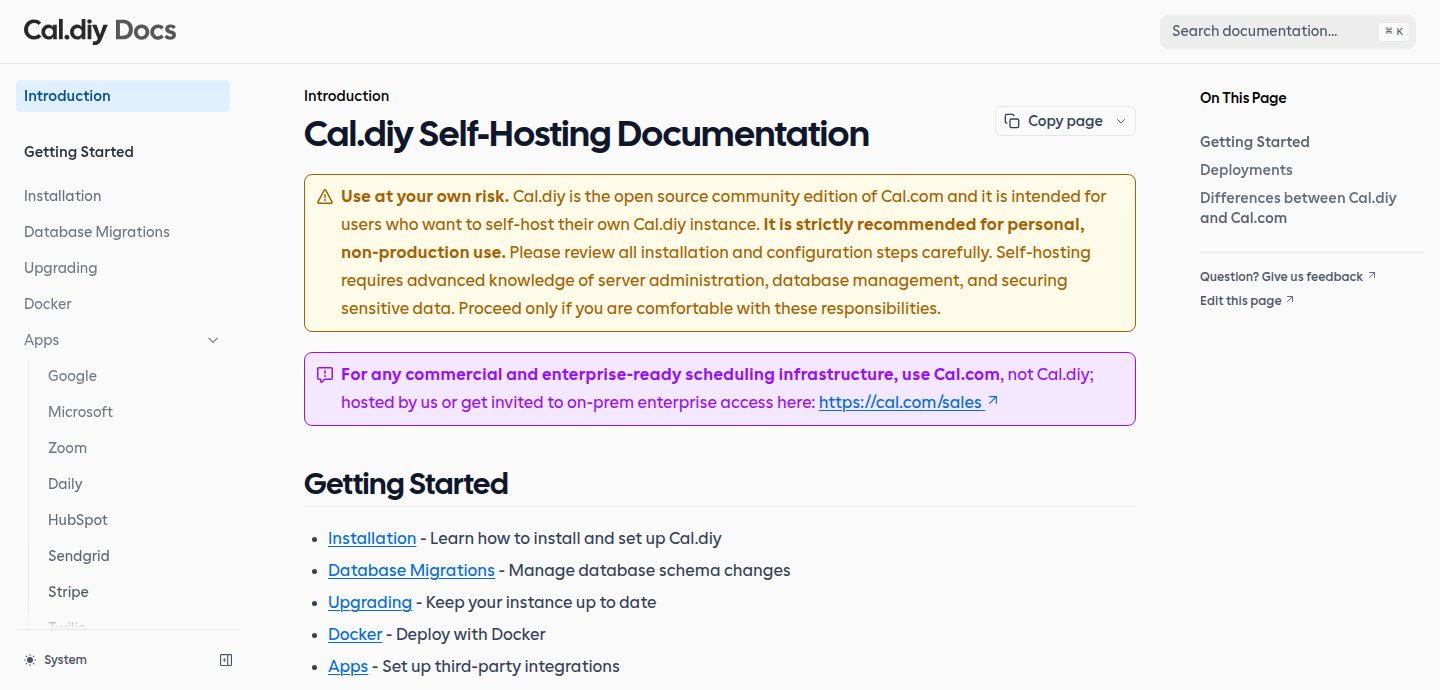
ProductivityThe open-source community edition of Cal.com: a scheduling and booking-page tool you can self-host. It is MIT licensed; Cal.com itself has been closed source since April 2026.
Open-source alternative to:
What the free edition leaves out
The free edition is genuinely usable, but some team or enterprise features need a paid plan. “Not confirmed” means the official pages we read did not say, so we do not guess.
| Feature | Free edition | Details | Source |
|---|---|---|---|
| SSO / SAML | Paid | The Cal.com blog lists SAML/SSO signup among features removed from Cal.diy. The pricing page lists SAML SSO and SCIM under the Organizations plan of the hosted product. | Source ↗ |
| Role-based access control | Paid | The pricing page lists role-based permissions under Organizations. The Cal.diy README says Teams and Organizations were removed. | Source ↗ |
| Audit logs | Not confirmed | The Cal.com blog lists Booking Audit as removed from Cal.diy. The pricing page does not mention audit logs, so the paid plan is unclear. | Source ↗ |
| Multi-user / teams | Paid | The pricing page limits the Free plan to 1 user and sells Teams and Organizations plans. Cal.diy removed Teams and Organizations. | Source ↗ |
| Backups and restore | Not confirmed | Not described on the pages read. Data lives in your own database. | Source ↗ |
| API access | Free | The Cal.com blog says Cal.diy ships with API v2 only and that API v1 was removed. | Source ↗ |
| Support SLA | Paid | The pricing page lists SLA and uptime guarantees and priority Slack and account support only under Enterprise. No support is described for Cal.diy. | Source ↗ |
Best for
Individuals who want to self-host a personal booking page and are fine with no teams, organizations or workflows.
Why choose it over Calendly
Cal.diy is MIT licensed and can run on your own server, which Calendly does not offer. No license key is required, and the README says everything in it works without a Cal.com account. The Cal.com cloud Free plan costs $0 for one user.
Where it falls short
Cal.com itself is no longer open source: the company moved its production code to a private repository in April 2026, and Cal.diy has had Teams, Organizations, Routing Forms, Workflows, Insights, SAML/SSO signup and Booking Audit removed. The project calls Cal.diy intended for personal, non-production use and says there is no hosted version of it. Enterprise on-prem access to the commercial edition goes through sales. The company says it hopes to return to open source one day.
Open-source alternative to
- Calendly — Cal.diy is a self-hostable scheduling tool with booking pages and calendar integrations, so it covers the same basic job as Calendly.
Category
ProductivityTopics
Tech stack
 TypeScript
 Docker
Languages as reported by GitHub for the repository.


